
Crates and consumer guide
Crates and consumer guide
ami-rust is a standard Cargo cross-toolchain for the two qualified PC x86-64 AROS targets:
| Target | Select when the guest runs | Native library-base convention |
|---|---|---|
x86_64-unknown-aros-abi1 |
AROS ABI-v1 | final ordinary call argument |
x86_64-unknown-aros-abi11 |
AROS ABI-v11 | r12 |
The target name is the ABI selector. Do not try to select ABI-v1 or ABI-v11
through a Cargo feature, cfg override, or a custom linker invocation. A
program and every dependency must use one target for one build.
Select a crate
| Crate | Use it for | Safe boundary |
|---|---|---|
aros |
Application entry, task-local context, Exec-backed allocation, files, streams, libraries, signals, local ports and messages | Default application crate |
aros-sys |
A raw AROS declaration or vector call not yet available through aros |
Unsafe; caller owns every pointer, library base and lifetime |
aros-mui |
Typed MUI objects, ownership scopes, attributes, notifications, callbacks, requesters, and the application loop | Preferred MUI crate |
aros-mui-sys |
A raw MUI vector, class, tag, or message not safely modelled by aros-mui |
Unsafe; caller owns the complete native contract |
aros-native-build |
The build.rs integration that compiles the selected native bridge and verifies its inputs |
Build dependency only; applications do not call it |
All five packages are Git-delivered for 0.1.0 and intentionally absent from crates.io. The following immutable revision is the 0.1.0 source release:
rev = "8456843ca869a738dde6dc7b7a062a2fdc3b6597"Start a graphical application
Create the package, then add the following files. This is the standalone form of the MUI hello example.
Cargo.toml:
[package]name = "my-aros-window"version = "0.1.0"edition = "2024"
[dependencies]aros = { git = "https://github.com/metaneutrons/ami-rust", rev = "8456843ca869a738dde6dc7b7a062a2fdc3b6597", features = ["alloc"] }aros-mui = { git = "https://github.com/metaneutrons/ami-rust", rev = "8456843ca869a738dde6dc7b7a062a2fdc3b6597" }
[build-dependencies]aros-native-build = { git = "https://github.com/metaneutrons/ami-rust", rev = "8456843ca869a738dde6dc7b7a062a2fdc3b6597" }build.rs:
fn main() { aros_native_build::prepare(Default::default()).expect("AROS native bridge");}src/main.rs:
#![no_main]#![no_std]
use aros::{AppStatus, Context};use aros_mui::{    Error, LoopControl, Mui, ReturnId, Trigger,    attributes::{        ApplicationBase, ApplicationTitle, Frame, GroupHoriz, TextContents, WindowCloseGadget,        WindowCloseRequest, WindowOpen, WindowTitle,    },    classes::{Application, Group, Text, Window},    values::FrameValue,};
fn run(context: &Context) -> Result<(), Error> {    let mui = Mui::open(context)?;    let result = mui.scope(|scope| {        let heading = scope            .builder::<Text>()            .with::<TextContents>(c"Hello from Rust on AROS")?            .with::<Frame>(FrameValue::Text)?            .build()?;        let root = scope            .builder::<Group>()            .with::<GroupHoriz>(false)?            .build()?;        root.adopt(heading)?;        let window = scope            .builder::<Window>()            .with::<WindowTitle>(c"My AROS window")?            .with::<WindowCloseGadget>(true)?            .build()?;        window.adopt(root)?;        let app = scope            .builder::<Application>()            .with::<ApplicationBase>(c"MYAROSWINDOW")?            .with::<ApplicationTitle>(c"My AROS window")?            .build()?;        app.adopt(window)?;        window            .notify::<WindowCloseRequest>(Trigger::Value(true))?            .return_id(app, ReturnId::QUIT)?;        window.set::<WindowOpen>(true)?;        app.run(|_| LoopControl::Continue).map(|_| ())    });    mui.close()?;    result}
fn application(context: &Context) -> AppStatus {    run(context).map_or(AppStatus::Error, |_| AppStatus::Success)}
aros::entry!(application, alloc);
The application owns native MUI objects only inside Mui::scope. Children are
attached with adopt; the scope disposes native roots when it returns. Do not
move an object, hook, callback, or custom class handle outside that scope. Use
aros-mui-sys only after documenting the raw pointer, tag, vector, and
lifetime contract that prevents a safe wrapper.
Configure Cargo and build
Place this in the consumer project’s .cargo/config.toml:
[target.x86_64-unknown-aros-abi1]linker = "aros-link"rustflags = ["-Zunstable-options"]
[target.x86_64-unknown-aros-abi11]linker = "aros-link"rustflags = ["-Zunstable-options"]
Use the versioned toolchain installed from the authenticated 0.1.0 distribution. The initial resolution writes the lockfile; commit it. Subsequent builds are locked and may run offline after a successful fetch:
toolchain=0.1.0cargo +"$toolchain" build --target x86_64-unknown-aros-abi1 --releasegit add Cargo.lockcargo +"$toolchain" fetch --lockedcargo +"$toolchain" build --target x86_64-unknown-aros-abi1 --release --locked --offlinecargo +"$toolchain" build --target x86_64-unknown-aros-abi11 --release --locked --offlineDo not put the entire ami-rust bin directory ahead of rustup proxies and do
not set RUST_TARGET_PATH. The installed toolchain supplies the paired target
specification, libraries, C SDK, aros-link, and native collector. It remains
a cross-toolchain: rustc and Cargo run on macOS or Linux, while the executable
runs on the selected AROS guest.
Scope and compatibility
The 0.1.0 release supports no_std plus alloc, not full std. Its native
evidence covers the qualified QEMU profiles for ABI-v1 and ABI-v11. It does not
establish support for a different CPU, physical hardware, arbitrary crates,
threads, networking, or an AROS-hosted Rust compiler. See the
compatibility boundary and API inventory for
the exact limits.
mui-hello qualification
mui-hello is built and run natively for both targets as part of this change.
The ABI-v11 capture below is an authentic QEMU framebuffer image, stored as
WebP.
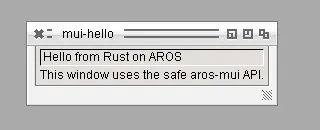
The example is maintained as a focused consumer of the safe MUI surface.